
Generator Wattage Estimator
Find out what size generator you need. Tick the appliances you want to run during an outage or on a job site, and the estimator adds up running watts and the largest starting surge to recommend a generator size — then get the printable sizing worksheet and wattage chart pack.
- Instant download
- Editable Excel & Word
- Print-ready PDF
- 7-day refund
6 files · XLSX, PDF, DOCX
Generator Sizing Worksheet Pack
Excel generator sizing worksheet, 60+ appliance wattage chart, printable sizing and load priority sheets, safety checklist and fuel log.
- Generator sizing workbook (XLSX, PDF)
- Appliance wattage chart (PDF, XLSX)
- Printable sizing worksheet (PDF, DOCX, XLSX)
- + 3 more
$5.00 USD, one-time 6 files · about $0.83 each
- Instant download
- 7-day refund
- Secure checkout by Stripe
7-day money-back guarantee. Full refund within 7 days of purchase, even after you download.
Free sample: Generator Sizing Workbook (PDF, 52 KB)
Generator Sizing Worksheet Pack
Excel generator sizing worksheet, 60+ appliance wattage chart, printable sizing and load priority sheets, safety checklist and fuel log.
- Generator sizing workbook (XLSX, PDF)
- Appliance wattage chart (PDF, XLSX)
- Printable sizing worksheet (PDF, DOCX, XLSX)
- Load priority planner (PDF, DOCX, XLSX)
- Safety checklist (PDF, DOCX)
- Fuel & run-time log (PDF, DOCX, XLSX)
Formats: XLSX, PDF, DOCX. Instant download after payment (link valid 72 hours, up to 5 downloads). AI-assisted: the templates were drafted with AI help and reviewed and laid out before publishing.
$5.00 USD, one-time 6 files · about $0.83 each
- Instant download
- 7-day refund
- Secure checkout by Stripe
7-day money-back guarantee. Full refund within 7 days of purchase, even after you download.
Free sample: Generator Sizing Workbook (PDF, 52 KB)
Full refund within 7 days — see the refund policy and license.
Free printables
Single sheets you can print right now, no sign-up. The full pack adds every sheet in one download plus the editable files.
 Printable Generator Wattage Estimator1 page · free PDF
 Printable Appliance Wattage Chart1 page · free PDF
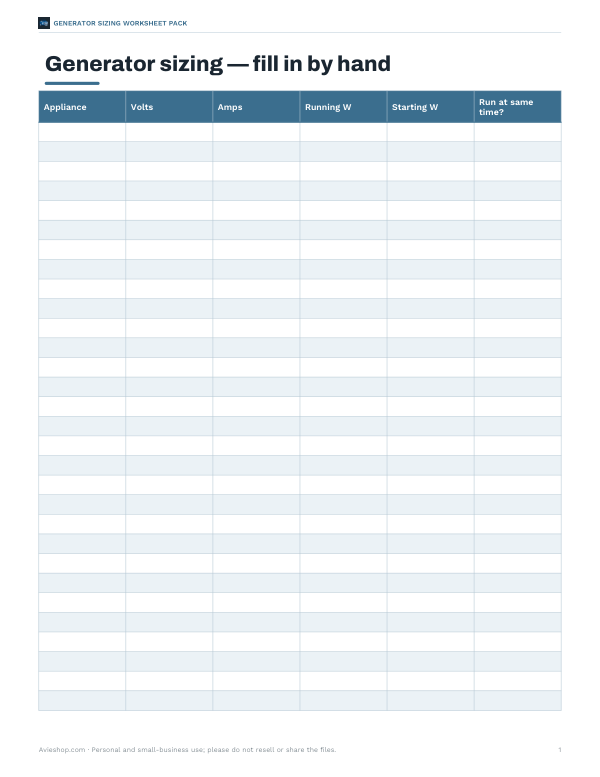 Printable Generator Sizing Worksheet1 page · free PDF
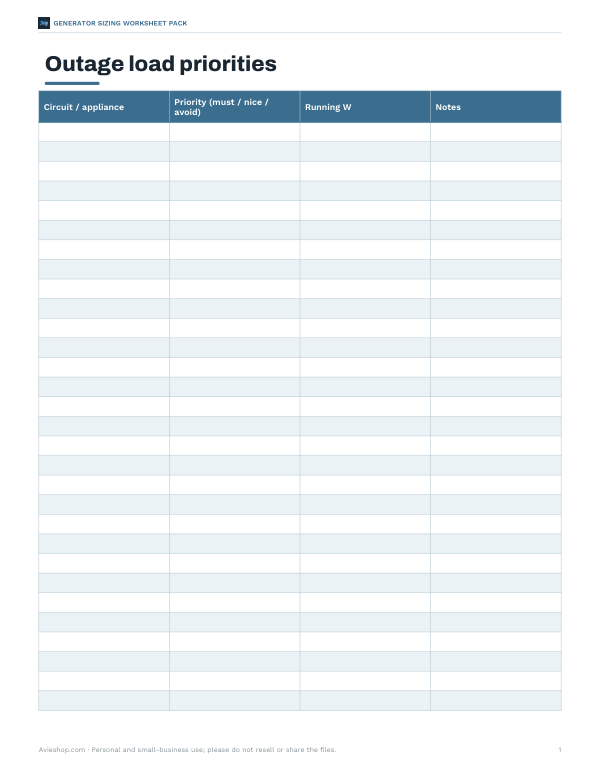 Printable Load Priority Planner1 page · free PDF
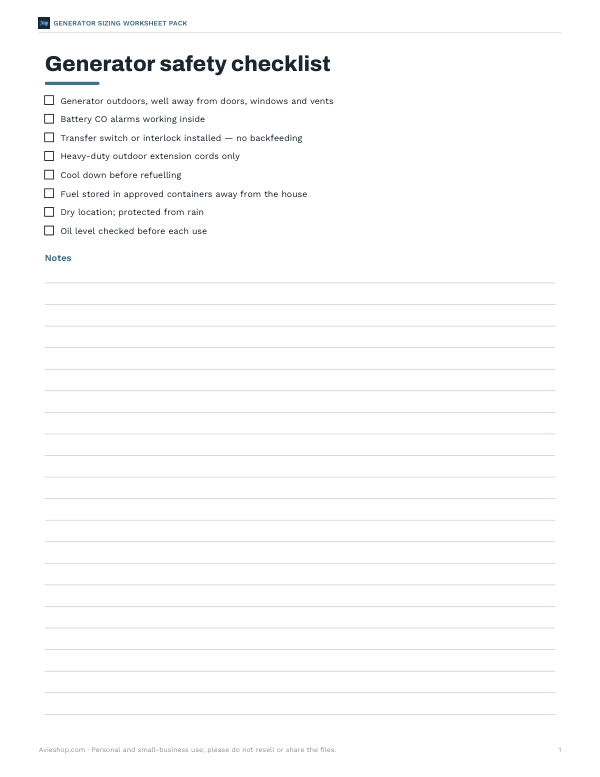 Printable Generator Safety Checklist1 page · free PDF
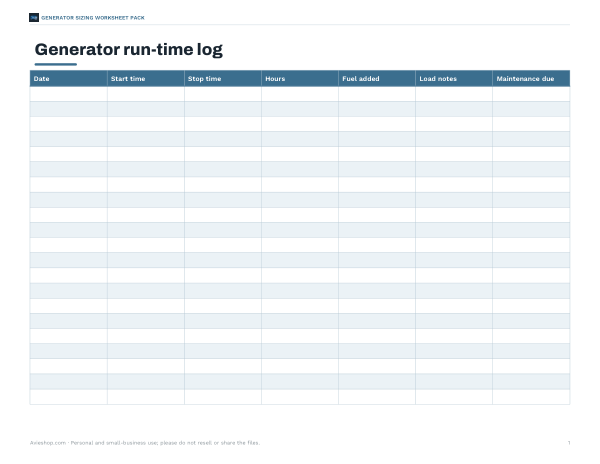 Printable Generator Run-Time Log1 page · free PDF
Estimate generator wattage
| Use | Appliance | Running W | Starting W | Qty |
|---|
Running watts and starting watts
Every appliance has a running (rated) wattage — the power it draws while operating. Appliances with electric motors or compressors, such as refrigerators, pumps, air conditioners and power tools, also need a brief surge of extra power to start, called starting or surge watts, often two to three times their running watts for a second or two. Generators are rated for both: a continuous running rating and a higher peak or starting rating. To size a generator, you need enough running watts for everything that will run at once, and enough headroom for the largest single motor to start while the rest are running.
How the estimator calculates
- Add the running watts of every appliance you will use at the same time.
- Find the one appliance with the largest extra starting surge (starting watts minus running watts).
- Peak demand = total running watts + that largest surge.
- Add a safety margin — 20% is common — so the generator is not running at its limit.
Start motor loads one at a time. If two motors start together, both surges add up and can overload a generator that is otherwise large enough.
Worked example: essential home backup
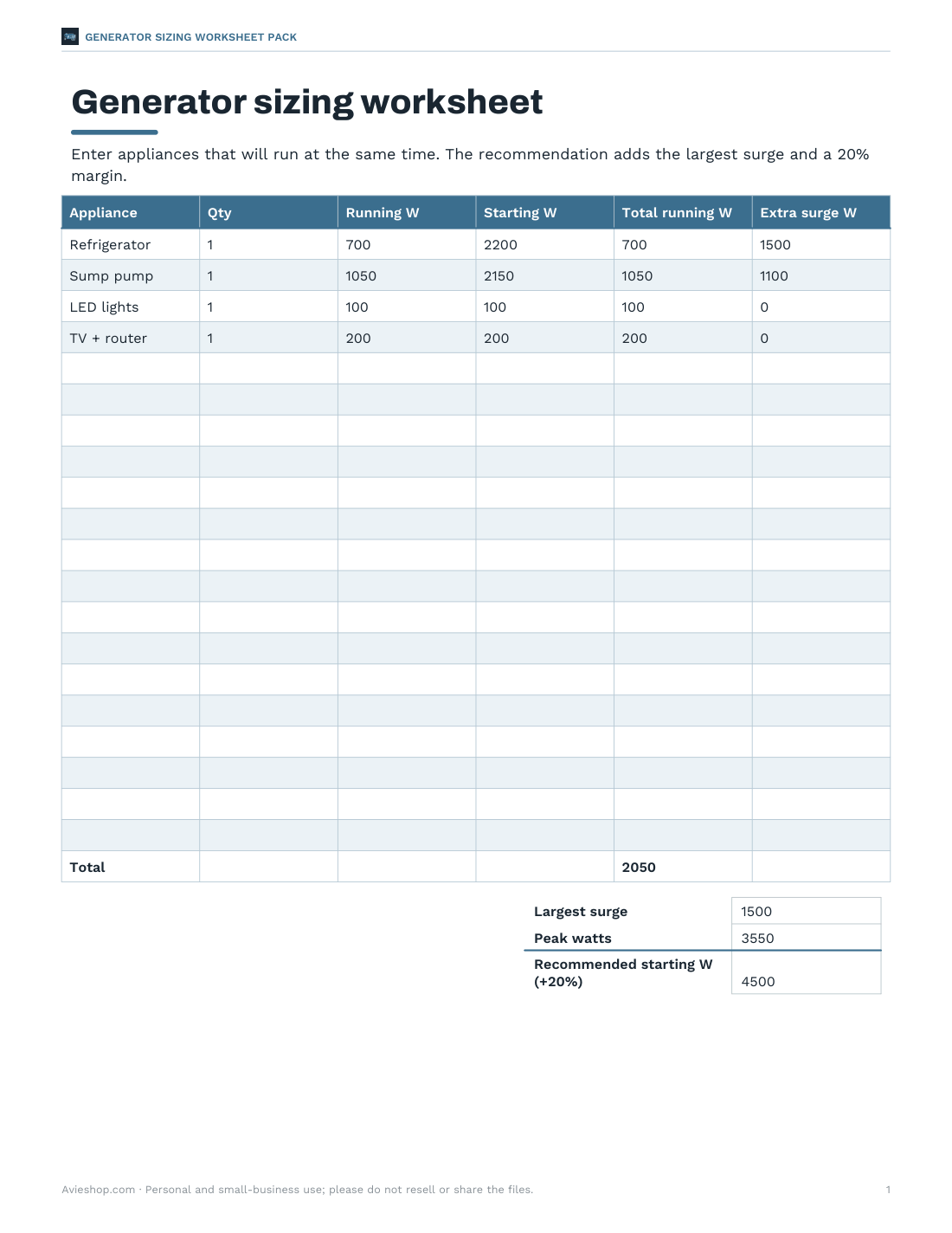
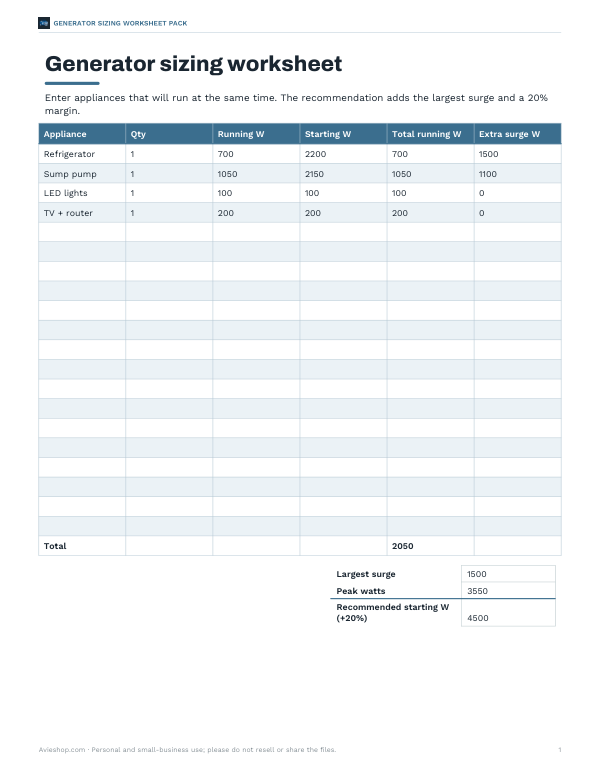
A refrigerator (700 running / 2,200 starting), a sump pump (1,050 / 2,150), LED lights (100), a TV and router (200) and phone charging (100) add up to 2,150 running watts. The largest surge comes from the refrigerator: 1,500 extra watts. Peak demand is 3,650 W. With a 20% margin, the estimator recommends a generator rated for at least about 4,500 starting watts and 3,000 running watts — a common size class for portable generators that power essential circuits.
What is in the sizing pack
- Generator sizing worksheet (Excel) — list appliances with running and starting watts; totals, peak and recommendation calculate automatically.
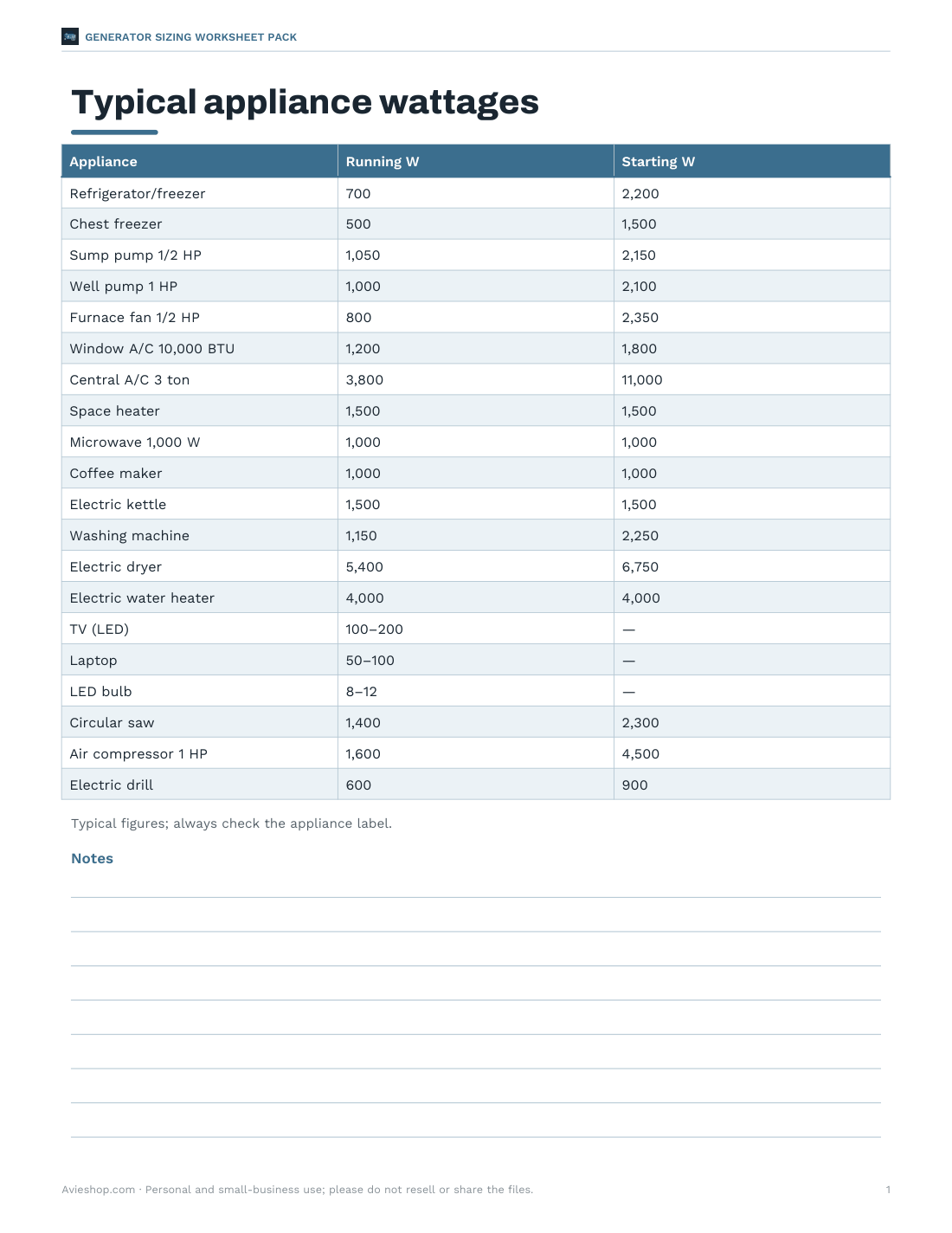
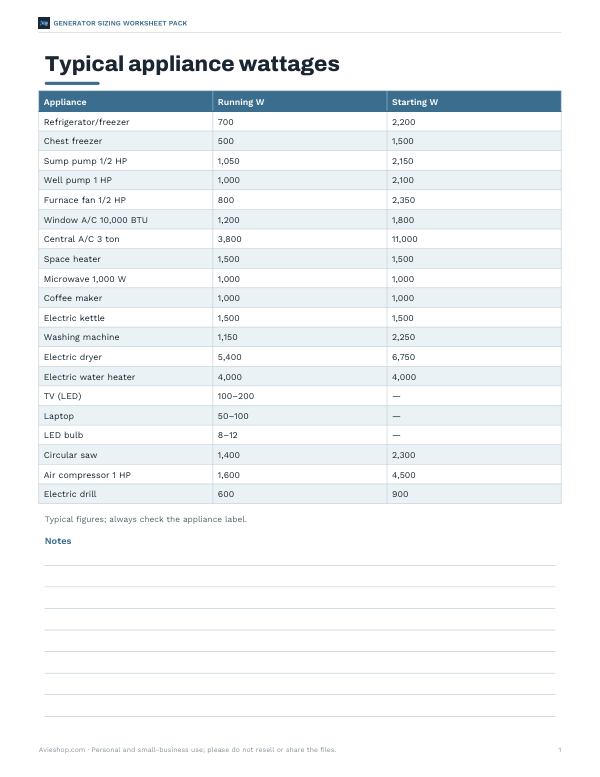
- Appliance wattage chart — typical running and starting watts for over 60 household and job-site appliances.
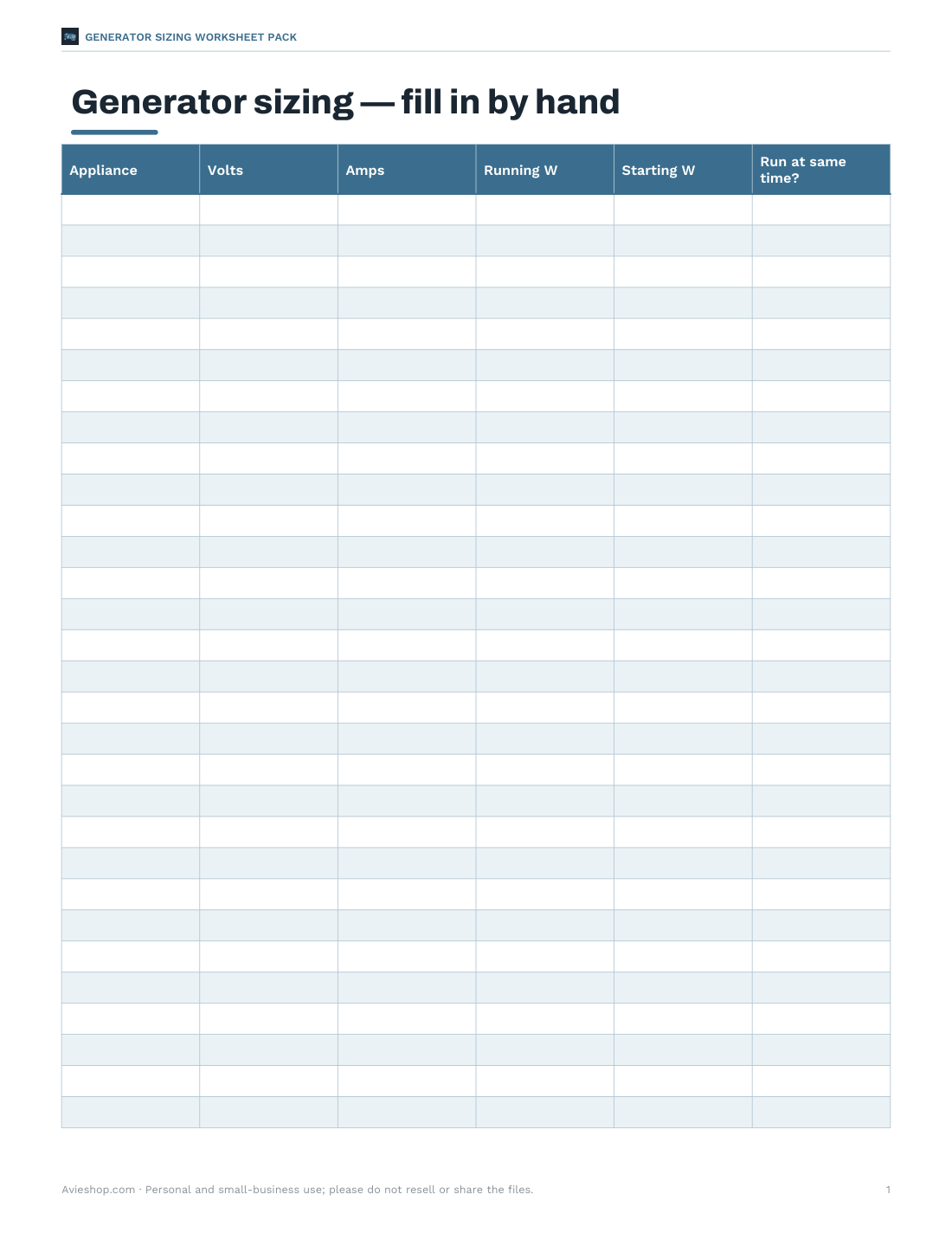
- Printable sizing worksheet (PDF/Word) — fill in by hand from the labels on your appliances.
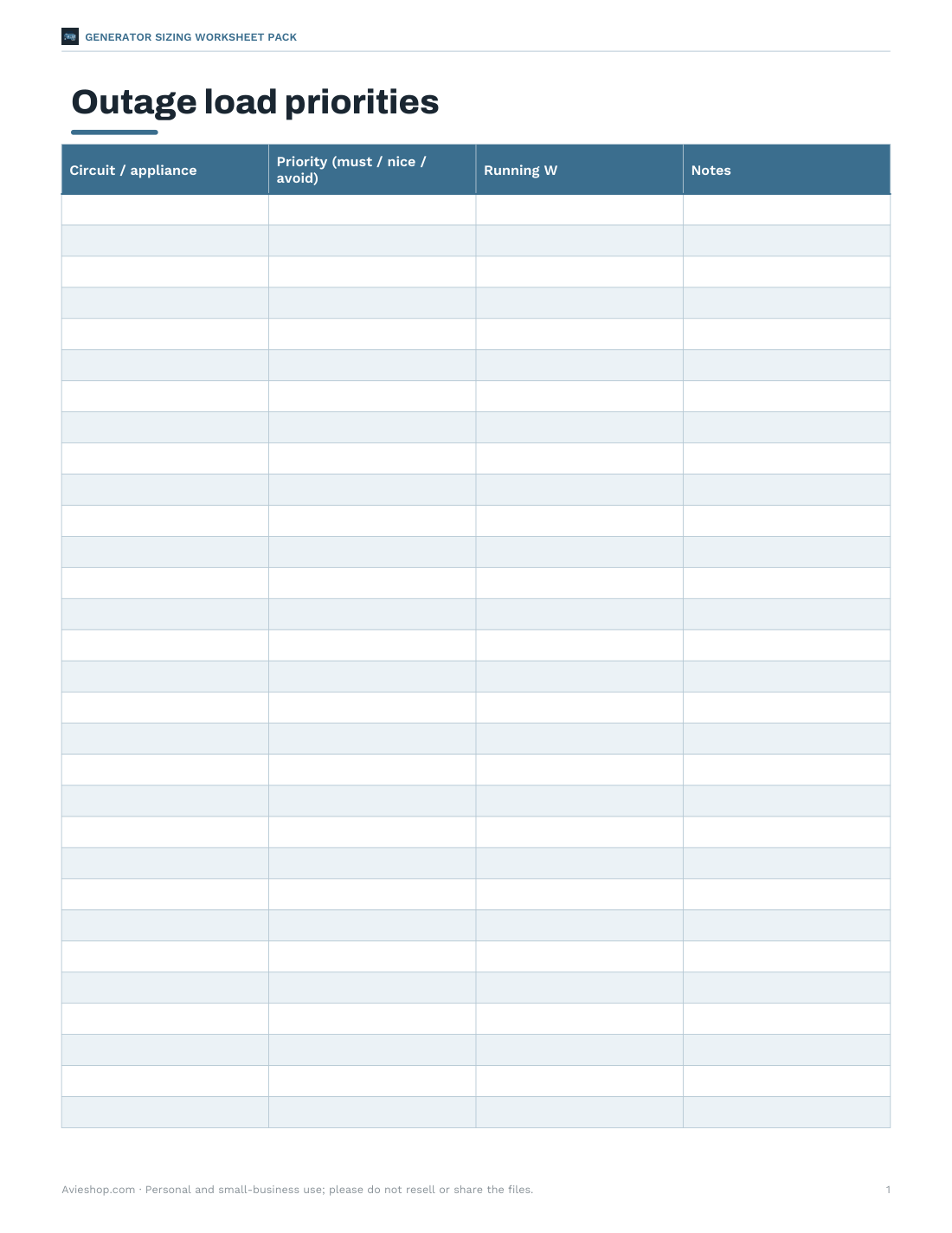
- Load priority planner — rank circuits for an outage: must-have, nice-to-have, avoid.
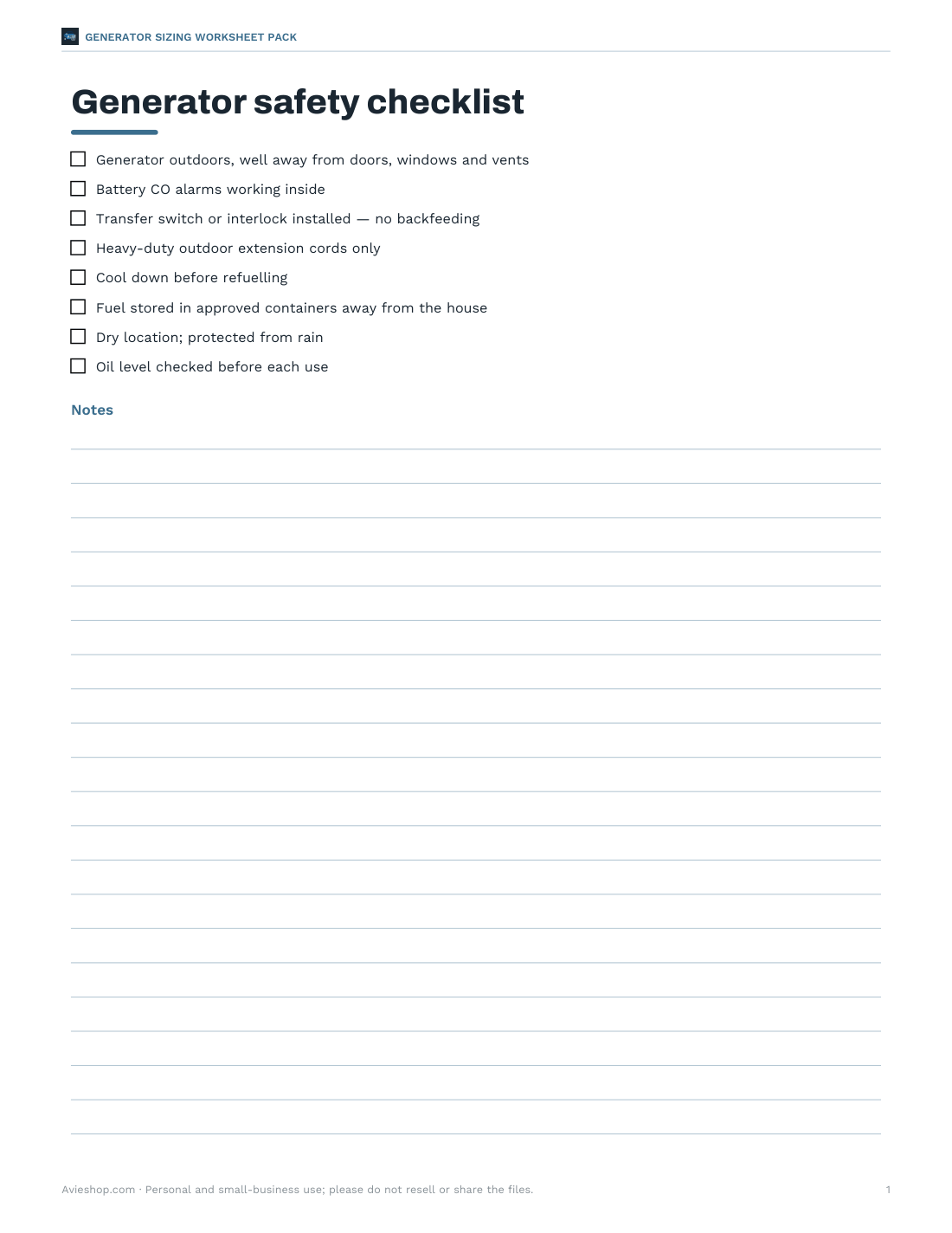
- Generator safety checklist — placement, carbon monoxide, fuel storage and connection.
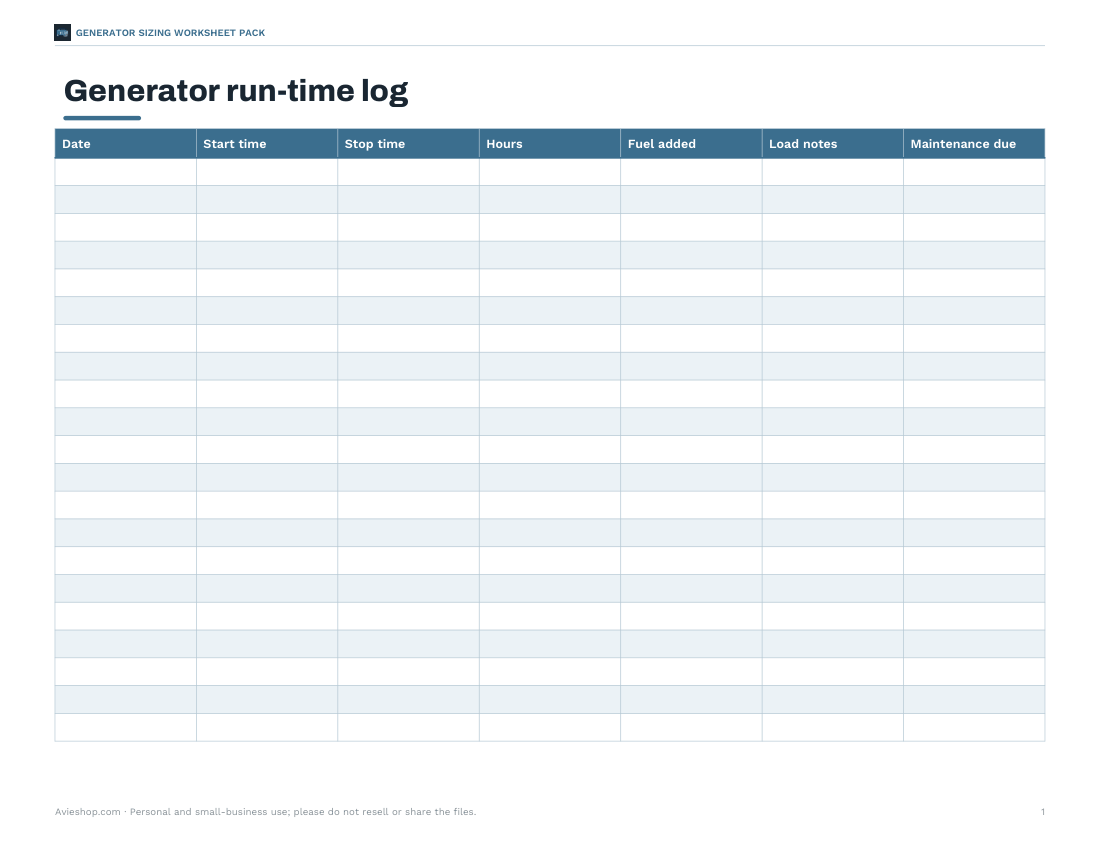
- Fuel run-time log — track run hours and refuelling.
Generator safety essentials
- Never run a generator indoors, in a garage, basement or crawl space, even with doors open. Carbon monoxide is odourless and can kill.
- Place it outdoors, far from windows, doors and vents, following the manufacturer's distance guidance.
- Install battery-powered CO alarms inside the home.
- Never backfeed a house by plugging a generator into a wall outlet — it can electrocute utility workers. Use a transfer switch or interlock installed by a licensed electrician, or heavy-duty extension cords to individual appliances.
- Turn off and let the generator cool before refuelling; store fuel in approved containers away from living areas.
Portable, inverter or standby?
| Type | Typical size | Best for |
|---|---|---|
| Inverter portable | 1,000–4,000 W | Camping, RVs, sensitive electronics; quiet and efficient |
| Conventional portable | 3,000–10,000 W | Home backup of essentials, job sites |
| Home standby | 10–26 kW and up | Automatic whole-home or large-load backup via transfer switch |
Sensitive electronics such as computers and some medical equipment are best powered by inverter generators, which produce cleaner power. Check the specifications for total harmonic distortion if this matters for your equipment.
Reading appliance labels
The data plate on an appliance lists watts, or volts and amps. Multiply volts by amps for an approximate wattage: a 120-volt pump drawing 8.7 amps uses about 1,044 W. Starting watts are rarely printed; manufacturers' manuals sometimes list locked-rotor amps (LRA) for compressors, which indicates the starting current. When in doubt, use conservative figures from the chart or ask the manufacturer.
Planning fuel and run time
A generator's fuel use rises with load. Manufacturers usually quote run time at 25% or 50% load; at higher loads the tank empties much faster. Running only essential loads, cycling high-draw appliances such as a well pump or water heater, and choosing an efficient inverter model all stretch fuel. Store enough fuel for a realistic outage, rotate stored petrol or add stabiliser, and keep a log of run hours so maintenance such as oil changes happens on schedule.
Frequently asked questions
What size generator do I need to run a refrigerator?
A typical fridge needs around 700 running and 2,200 starting watts, so a generator of at least about 3,000 starting watts, more if other loads run too.
What is the difference between starting and running watts?
Starting watts are a short surge motors need to start; running watts are the continuous draw.
Can a generator run central air conditioning?
Often only large portable or standby generators can; central A/C can need 10,000 W or more to start. A soft-start kit can reduce the surge.
How do I connect a generator to my house?
Through a transfer switch or approved interlock installed by a licensed electrician — never by backfeeding through an outlet.
Is this pack editable?
Yes, the Excel and Word files are editable.
Was AI used to create the pack?
The templates were drafted with AI assistance and then checked, edited and formatted before publishing.